Octoqin
Digital Musical Instrument
2019.9
Project Members
Mei Zhang
Jack Ratcliffe
Francesco Soave
Zhaorui Liu
Ye Li
Fengrui Zhang
Jingxian He
MY ROLE
Sound and Interaction Design
TOOLS
Bela
IMU, Fabric Pressure Sensor
Pure Data
SURPPOTED BY
A modern and absurdist recreation of the traditional Chinese Duxianqin
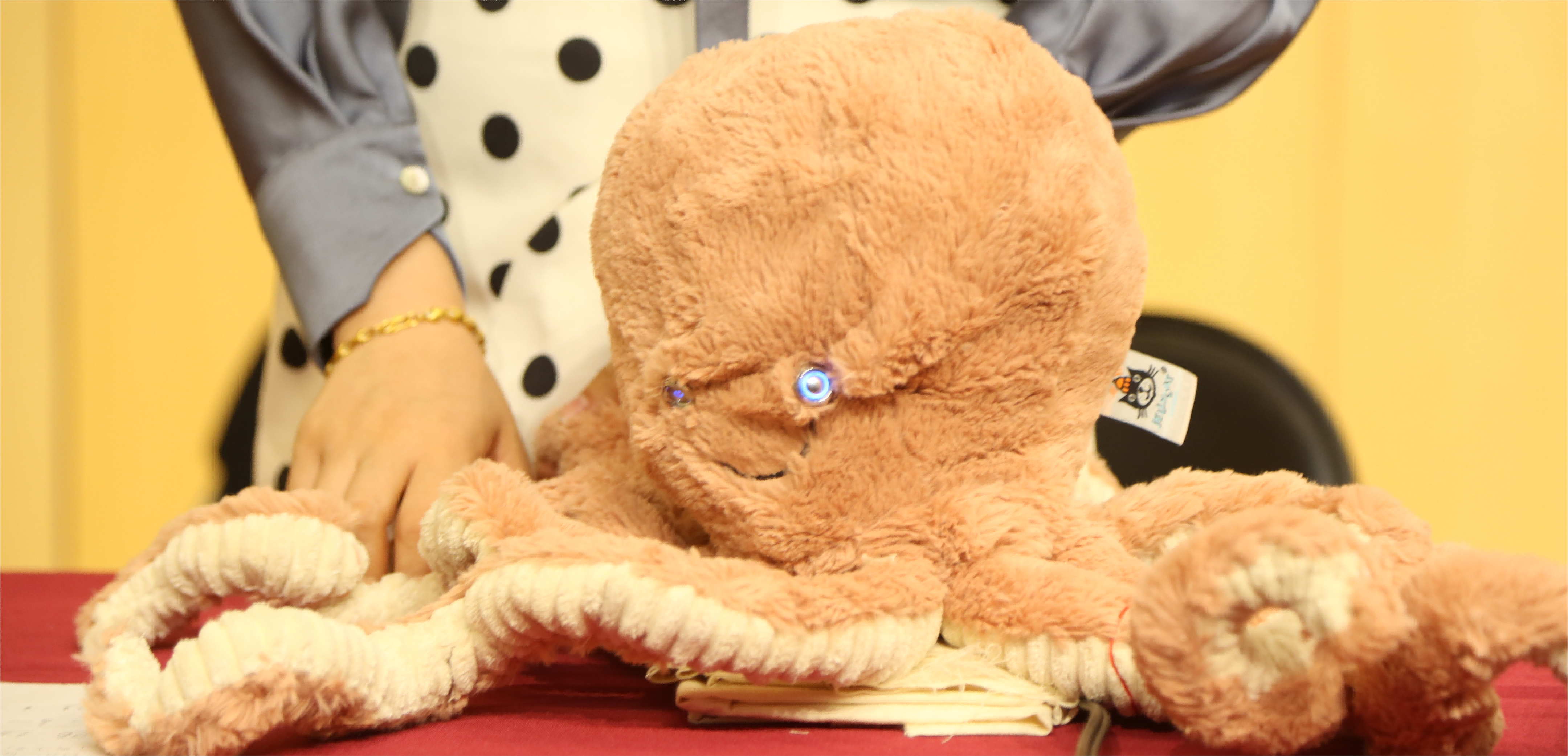
The Octoqin is a modern and absurdist recreation of the Chinese traditional musical instrument -- Duxianqin, one-stringed instrument, created to test the boundaries of what one can consider an instrument, and what one can consider a duxianqin. Using cutting-edge sound synthesis, etextiles and a plush octopus, the Octoqin is made and played here at the Central Conservatory of Music, Beijing, China.
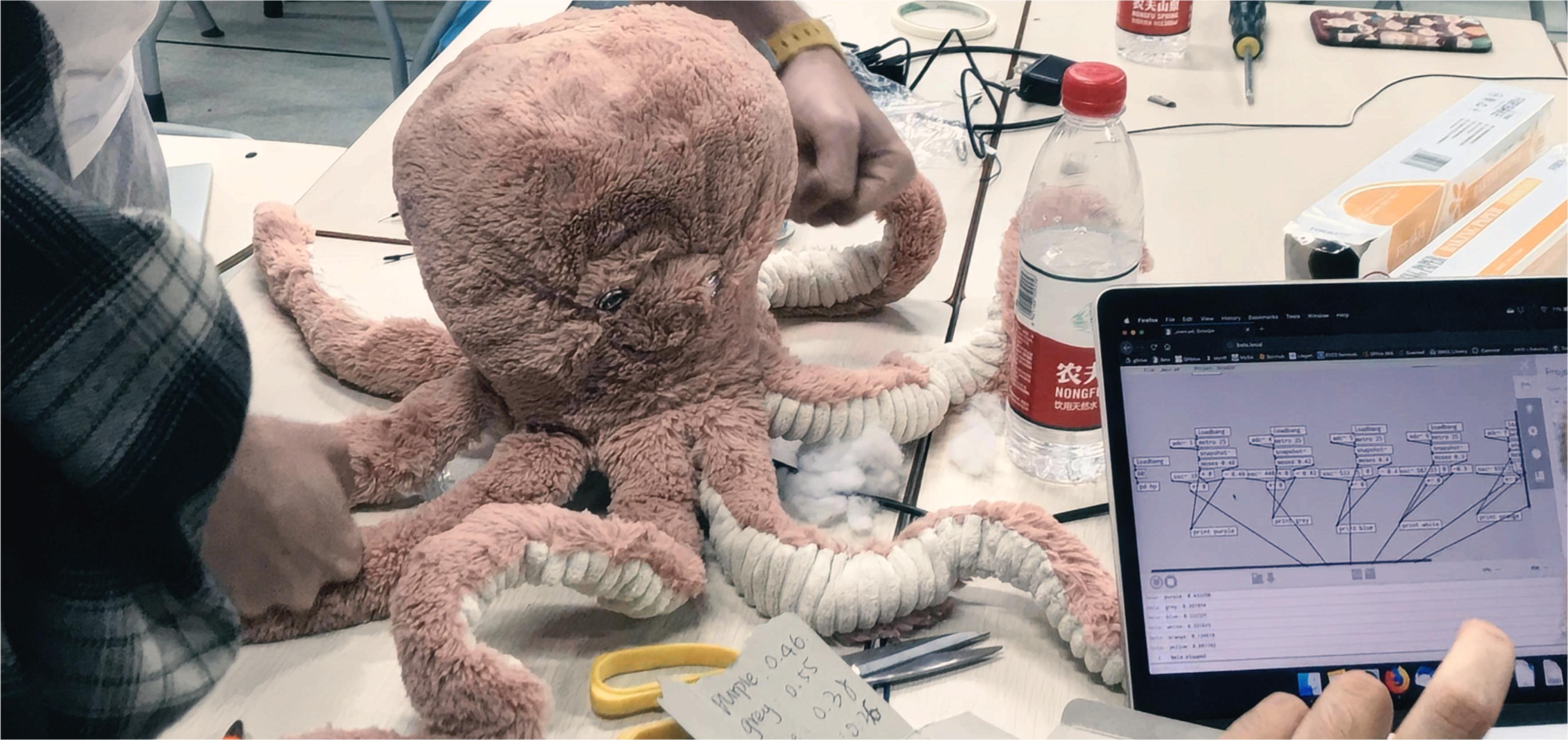
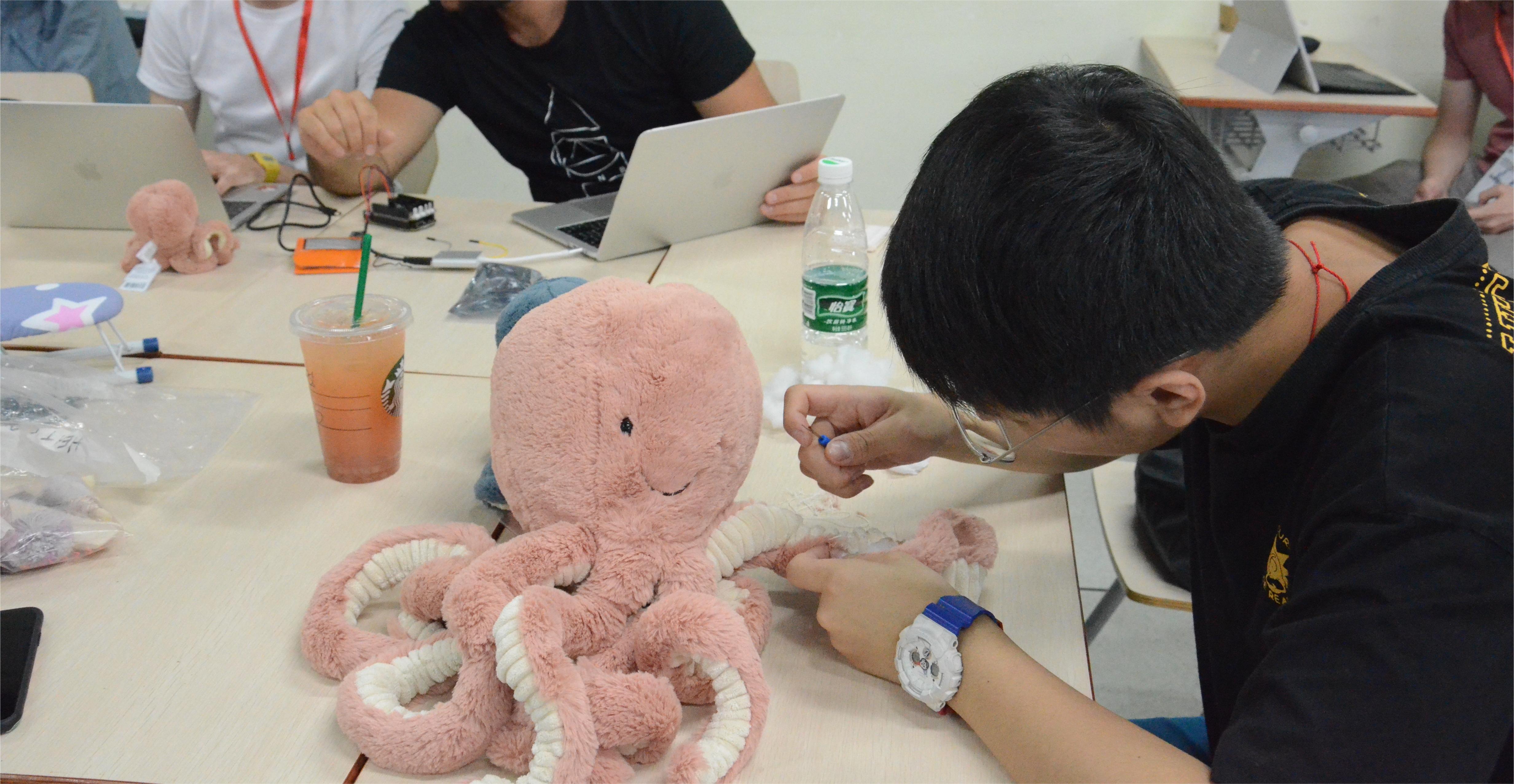
The Octoqin is made from an Octopusshaped doll, with six cloth pressure sensors sewn inside six of the legs to map to the six overtone positions on the string of a traditional Duxianqin. When the legs of the Octoqin are squeezed a recording of the note from a traditional Duxianqin is played by Bela with strength of squeeze mapped to volume. Movement of the Octoqin's head modifies pitch of the note produced, much like the joystick in the traditional Duxianqin.
The fabric pressure sensor is made by sewing the upper layer fabric (No.1), lower layer fabric (No.2), and conductive sponge (No.4) sandwiched between them through seam (No.6). There is a conductive fabric (No.3) with the same position and area size on the upper layer fabric (No.1) and lower layer fabric (No.2), and a resistor is connected in the area where there is no conductive fabric (No.3) on the lower layer fabric (No.2). The conductive fabric is made by adding conductive fibers to the traditional fabric structure, making it conductive. When combined with a conductive sponge, the pressure acting on the surface can change the resistance value, thereby serving as a pressure sensor to sense the magnitude of pressure.
Related Paper & Video
Bryan-Kinns N, Li Z. ReImagining: cross-cultural co-creation of a Chinese traditional musical instrument with digital technologies[J]. In NIME’20, 2020: 1-6.